Why mobility is at the center of smart city performance
For most residents, the quality of urban mobility shapes daily life more directly than almost any other public system. Commute duration affects work opportunities, family time, safety, health, and financial stress. Street design influences whether children can walk to school, whether older adults can move comfortably, and whether small businesses receive footfall. Public transport reliability affects access to jobs and services. Traffic management influences emissions, fuel consumption, and emergency response time. It is no surprise, then, that smart mobility has become a central theme in discussions about smart cities in India. A city may have advanced governance systems and digital platforms, but if movement remains chaotic, unsafe, and unequal, residents are unlikely to experience urban life as truly improved.
India’s mobility challenge is complex because transport demand is growing rapidly while street space remains limited and many cities are shaped by layered, mixed, and often informal patterns of use. Roads serve not just cars, but buses, bicycles, two-wheelers, freight, pedestrians, street vendors, service vehicles, and paratransit. Any smart mobility strategy that assumes a simple shift toward automobile optimization is therefore misguided. The most effective smart transport systems in India recognize the diversity of urban movement. They aim to improve public transport, support walking and cycling, reduce unnecessary congestion, manage traffic more intelligently, and strengthen last-mile connections to high-capacity transit. In other words, they seek integration rather than isolated fixes.
What makes mobility “smart” in this context is not merely the presence of apps or traffic cameras. It is the ability to make the whole movement ecosystem more coherent. That may involve synchronized signals, multimodal information systems, digital ticketing, route rationalization, accessible station areas, data-driven fleet management, parking strategy, and redesigned streets. Yet technology should remain a means, not an end. If commuters still have to navigate broken footpaths, dangerous junctions, and poorly connected station exits, a mobility app alone will not solve much. The Indian smart city model works best when digital tools are paired with street-level usability and institutional coordination.

Public transport as the backbone of an inclusive smart city
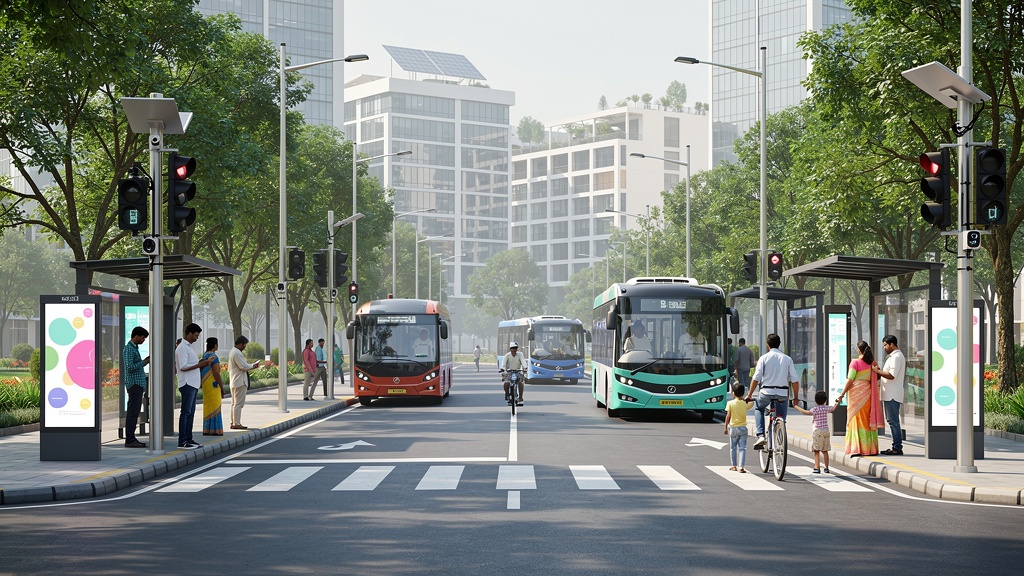
A city cannot become truly efficient if most people depend on private vehicles for everyday movement. Public transport remains the backbone of inclusive urban mobility because it can move more people with less space, lower emissions per capita, and greater affordability. In India, the spectrum of public transport includes metro rail, suburban rail, city buses, BRT or bus-priority systems, minibuses, ferries in some cities, and feeder services. Smart mobility planning seeks to strengthen these systems not only individually, but in relation to each other. A metro line may be modern and fast, but if passengers cannot reach the station safely, cannot transfer conveniently, or cannot find reliable last-mile options, its full value is diminished.
Buses deserve special emphasis because they remain the most flexible and scalable public transport mode in many Indian cities. Smart bus systems can improve service through GPS tracking, predictive arrival information, route planning tools, depot management, digital fare collection, and performance monitoring. Yet the basics still matter deeply: dedicated lanes where possible, stop design, passenger information clarity, safety, schedule reliability, and integration with major interchange points. In lower-density corridors or developing urban regions, buses may deliver more broad-based value than expensive fixed infrastructure if planned well. Smart city investments should therefore avoid over-focusing on prestige modes while neglecting bus system quality.
Affordability and accessibility are equally important. A smart transport system in India should work for students, low-income workers, women traveling at varied hours, older adults, and persons with disabilities. This requires universal design, lighting, legible wayfinding, ticketing simplicity, and predictable service frequency. Public transport that is technically advanced but difficult to use for large sections of the population does not fulfill the inclusive promise of smart urbanism.
Last-mile connectivity and multimodal integration
One of the most persistent challenges in Indian urban transport is the gap between major transit infrastructure and the traveler’s actual origin and destination. A metro station may be efficient, but the journey does not start or end at the platform. Last-mile connectivity determines whether public transport feels practical or burdensome. This is where e-rickshaws, feeder buses, shared mobility, bicycles, walking links, auto-rickshaws, and local shuttle systems become important. Smart mobility planning treats these not as marginal details but as integral parts of a multimodal ecosystem.
Integration involves physical design, information systems, and operational coordination. Station areas should have clear pickup zones, protected pedestrian movement, accessible routes, and conflict-minimized interchange design. Digital maps and signage should help users understand options quickly. Fare integration or payment interoperability can reduce friction. City agencies should avoid designing high-capacity transit nodes as if they operate independently from street life. In reality, the quality of the surrounding area strongly influences ridership and user satisfaction.
In India, multimodal integration also requires sensitivity to informality. Many cities rely heavily on informal or semi-formal transport services that fill essential mobility gaps. Rather than ignoring these systems, smart city transport planning should consider how to regulate, organize, and coordinate them without destroying their flexibility. A more integrated system can enhance safety and predictability while preserving accessibility. This is a more realistic approach than assuming all informal mobility can be replaced quickly by formal networks.
Street design, walkability, and non-motorized transport
The smartest mobility interventions are often found not in software but in street geometry. If a road is hostile to pedestrians, unsafe for cyclists, and difficult to cross, it undermines the mobility system as a whole. Indian smart cities increasingly recognize the importance of complete streets, which allocate space more rationally among different users and prioritize safety, comfort, and accessibility. This can include continuous footpaths, shaded sidewalks, protected cycling tracks where appropriate, traffic calming, median refuges, raised crossings, bus stop integration, street furniture, and better curb management.
Walkability is especially important because every trip contains a walking component. Even public transport users are pedestrians before and after boarding. Yet walking is often treated as residual. Broken pavements, parked vehicles, utility obstructions, open drains, poor lighting, and inconsistent crossings can make everyday movement exhausting or dangerous. A smart mobility city corrects this imbalance by viewing walking as transport infrastructure, not leftover space. The same principle applies to cycling in contexts where trips are short enough and routes can be designed safely. Non-motorized transport delivers health, environmental, and affordability benefits that are difficult to match through motorized solutions alone.
These changes also enhance urban life beyond transport metrics. Walkable streets can support commerce, social interaction, tourism, and neighborhood vitality. They encourage more equitable use of public space and reduce the dominance of private vehicles in dense urban settings. For India’s smart cities, street design may be one of the most powerful areas where mobility, sustainability, and inclusion converge.
Traffic management, data systems, and operational intelligence
Traffic congestion remains a major concern in Indian cities, and smart systems can help make road operations more efficient. Adaptive signaling, CCTV-based monitoring, incident detection, parking management, corridor analytics, and integrated traffic command centers provide cities with better operational visibility. These tools can reduce delay, support enforcement, improve safety responses, and help planners understand demand patterns. However, cities should be careful not to equate smart traffic management solely with moving private vehicles faster. The broader objective should be to improve the overall functioning of the street network in line with public goals.
This means using traffic data to support buses, emergency response, freight timing, pedestrian safety, and pollution reduction rather than simply maximizing throughput for cars. For example, signal systems can be tuned to improve bus priority or safer crossing intervals. Parking management can reduce chaotic curbside use. Incident data can identify high-risk junctions that need redesign rather than only enforcement. Freight movement can be timed to reduce conflict with commuter peaks. In this sense, smart traffic operations are most useful when integrated with broader transport planning instead of treated as a standalone engineering layer.
Data can also improve long-term decision-making. Travel demand patterns, intersection performance, ridership changes, and corridor-level behavior help cities allocate resources more intelligently. Yet the quality of analysis depends on institutional capacity and the willingness to act on findings. Technology does not replace planning judgment. It strengthens it when cities are prepared to interpret evidence and make difficult trade-offs.
Electric mobility and the future transport transition
Electric mobility is increasingly prominent in Indian urban transport discussions, especially as cities seek to reduce emissions and fuel dependency. Electric buses, two-wheelers, three-wheelers, and charging infrastructure all have the potential to transform local mobility systems. For smart cities, the challenge is to integrate electric mobility in a way that supports public goals instead of deepening inequality or congestion. Electrifying bus fleets, for example, can improve air quality and reduce operating emissions while serving large numbers of people. Supporting electric two- and three-wheelers can improve last-mile connectivity if charging networks and fleet economics are viable.
Charging infrastructure planning is critical. Cities need to think about depot charging, public charging, fleet operations, grid capacity, and land allocation. They also need to ensure that electric mobility policies align with broader mode-shift goals. An electric private car still occupies road space and can contribute to congestion. Therefore, electrification should be paired with public transport strengthening, walkability, and better street management. Smart mobility is not about replacing one inefficient system with another cleaner but equally space-intensive one; it is about redesigning movement for efficiency, fairness, and sustainability.
Over time, digital systems may support this transition through fleet monitoring, energy management, demand forecasting, and payment integration. But again, physical planning remains essential. Smart transport in India will be shaped not just by which technologies are adopted, but by which transport priorities cities choose to elevate.
What a successful mobility future looks like for Indian cities
The most successful smart mobility systems in India will likely share several characteristics. They will make public transport easier to use and more reliable. They will improve last-mile access instead of ignoring it. They will redesign streets for pedestrians and not only for vehicles. They will use data to support safer and more efficient operations. They will integrate different agencies and modes. They will consider gender, disability, and affordability. They will treat electric mobility as part of a broader transition rather than a standalone trend. Most importantly, they will judge success by how movement feels to ordinary users.
A resident may never see a command center or understand the software architecture behind a mobility system. But they will notice if a bus arrives on time, a crossing feels safer, a metro station is easier to access, or a street is more comfortable to walk. Those lived improvements are what ultimately validate the smart city concept. Mobility is where the abstract promise of urban intelligence becomes visible and measurable in daily life.
For India’s urban future, better mobility is not just about transport. It is about opportunity, safety, productivity, climate responsibility, and public dignity. A city that moves people well is a city that supports more equal access to urban life. That is why smart mobility should remain at the heart of long-term planning.