
Why sustainability is central to the smart city model
In India, sustainability is not a decorative add-on to smart city planning; it is one of its most practical foundations. Urban centers face rising temperatures, declining air quality, pressure on water resources, expanding waste streams, energy demand volatility, and recurring climate shocks such as flooding and heat stress. A city that installs digital systems but fails to address these ecological pressures cannot truly be considered future-ready. Sustainable infrastructure helps cities operate more reliably, reduce costs over time, protect public health, and create more comfortable everyday environments. It also improves the credibility of smart city investments by linking technology to tangible environmental outcomes.
The sustainable city agenda in India spans multiple layers: energy efficiency, renewable integration, water conservation, sewage and wastewater treatment, solid waste management, green mobility support, heat mitigation, public landscape design, and ecological restoration. Many of these functions benefit from digital monitoring, but their success depends equally on civil engineering, maintenance, governance, and public participation. For example, a city may use sensor-based water monitoring to detect losses, but it must also repair distribution networks and improve billing discipline. It may install smart bins or route optimization software, but these systems only work well when waste segregation, fleet management, and processing capacity are aligned. Sustainability in urban India is therefore best understood as a systems challenge that links physical infrastructure with behavior, policy, and data.
There is also an equity dimension. Environmental stress rarely affects all citizens equally. Low-income settlements may experience more severe heat exposure, less tree cover, poorer drainage, and more irregular access to clean water. Sustainable infrastructure becomes more meaningful when it reduces these disparities rather than improving only premium districts. A cooler, walkable street with shade and drainage can be as valuable as a high-tech control system. A dependable community-level water service can improve lives more deeply than a symbolic smart installation. This is why the sustainability side of smart cities in India deserves sustained attention: it connects modernization to health, resilience, and fairness.
Energy efficiency and renewable transition
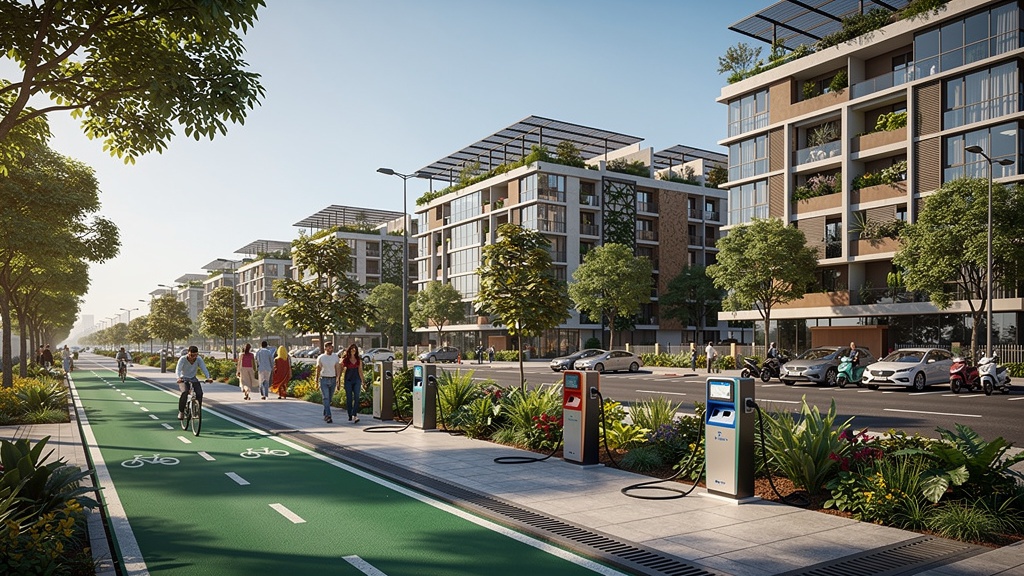
Energy is one of the clearest areas where smart and sustainable city priorities intersect. Indian cities need reliable power to support households, commerce, transport systems, healthcare, and digital operations. At the same time, they must reduce inefficiency and move toward cleaner energy sources where possible. Smart street lighting has been one of the more visible interventions in many urban programs because it produces practical benefits quickly. Remote monitoring can identify faults, dimming schedules can lower consumption, and LED upgrades can reduce energy costs while improving lighting quality. These changes matter for both municipal finances and public safety.
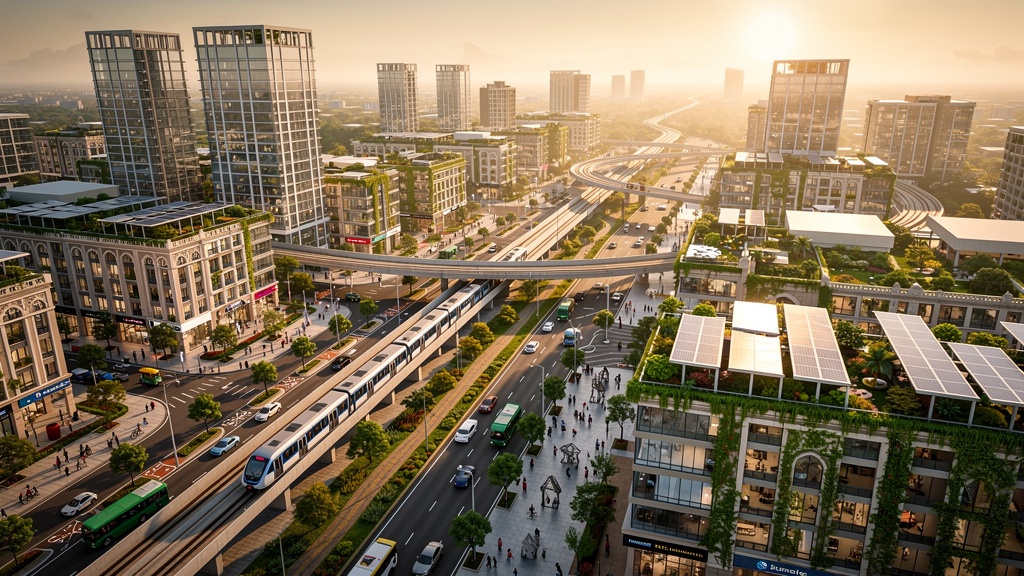
Beyond lighting, cities are increasingly interested in distributed renewable energy, rooftop solar on public buildings, solar-powered public amenities, and better load management for growing electric mobility ecosystems. Municipal offices, transit depots, schools, hospitals, bus shelters, and water facilities can all become part of a broader urban energy strategy. Smart metering and energy management systems help cities understand demand patterns, identify waste, and optimize operations. However, the energy transition should be planned carefully. Renewable deployment works best when supported by maintenance planning, financing models, technical standards, and user awareness. Cities that treat solar panels as one-time installations without upkeep may see performance decline.
There is also an opportunity to think more holistically about urban energy. Building design, material choices, shading, ventilation, and district-level planning all influence consumption patterns. Energy-smart cities are not only those that install technology, but those that reduce unnecessary demand through better urban form. In hot climates across India, cooling load is becoming increasingly significant. This makes reflective surfaces, tree cover, passive design, and building efficiency especially important. When sustainability is integrated at the planning stage, energy pressure becomes more manageable over time.
Water security, sewage, and circular resource thinking
Water management is arguably one of the most critical issues for smart cities in India. Many urban areas face a difficult mix of rising demand, groundwater stress, aging pipes, leakage, supply inequities, and increasing vulnerability to both drought and intense rainfall. Smart water systems can help improve visibility into supply and consumption, but water security ultimately depends on how cities combine infrastructure, ecology, and governance. SCADA-based monitoring, pressure management, leak detection tools, and meter data can all improve operational efficiency. Yet these technologies produce the best outcomes when paired with distribution upgrades, source protection, rainwater harvesting, wastewater reuse, and consumer trust.
Rainwater management is particularly important in Indian urban settings. Rapid construction, surface paving, and weakened drainage channels can increase flood risk dramatically. A sustainable smart city responds by redesigning streets, open spaces, and plots to absorb, store, slow, and channel water more intelligently. This may involve permeable paving, detention structures, restored lakes, urban wetlands, bioswales, improved stormwater mapping, and better maintenance of drains. In some cases, the most advanced intervention is not digital at all, but ecological restoration supported by better data and governance. Smartness lies in the integration.
Sewage and wastewater infrastructure are equally vital. A city that markets itself as smart while discharging untreated wastewater into rivers or lakes reveals a major gap between branding and reality. Sustainable infrastructure requires adequate collection systems, treatment capacity, decentralized solutions where suitable, and reuse strategies for landscaping, construction, or non-potable applications. Over time, Indian cities may increasingly move toward circular water models in which wastewater is treated as a recoverable resource rather than only a disposal challenge. Smart monitoring can support this transition, but governance and maintenance remain decisive.
Solid waste management and cleaner urban environments
Waste is one of the most visible markers of urban quality. Residents experience the smartness of a city not only through apps and transit systems, but through whether streets are clean, collection is reliable, public bins are well managed, and disposal practices are environmentally responsible. Smart solid waste management in India can involve route optimization, vehicle tracking, fill-level monitoring, complaint integration, and digital reporting. These tools help municipalities reduce inefficiency and improve supervision. But smart waste systems do not begin with software; they begin with segregation, collection design, transfer logistics, worker safety, and processing capacity.
Indian cities face diverse waste challenges, including mixed waste streams, informal recycling networks, plastic volume growth, construction debris, and variable citizen participation. Effective sustainable infrastructure must therefore combine municipal systems with community education, decentralized models where appropriate, and long-term planning for processing and recovery. Waste-to-energy debates, composting systems, material recovery facilities, and circular economy initiatives all belong to this broader conversation. The best results usually come when cities prioritize waste reduction and segregation first, then use digital tools to improve traceability and operational discipline.
Cleaner environments also depend on street maintenance, public toilet accessibility, drainage cleanliness, and the design of everyday urban spaces. Smart cities in India should be judged partly by whether they make basic public hygiene more dependable. This may sound ordinary, but it is foundational to dignity and public health. If sustainability is understood only in terms of advanced technology, cities risk neglecting the basics that shape citizen experience most directly.
Urban heat, public space, and human comfort
As temperatures rise across many Indian cities, thermal comfort is becoming a major urban planning issue. Heat affects productivity, public health, transport use, outdoor labor, and energy demand. Sustainable infrastructure can respond through better shading, increased tree canopy, water-sensitive design, high-albedo materials, cool roofs, and public spaces that are designed for comfort instead of exposure. These interventions are essential because a city that is too hot to walk in is unlikely to achieve mobility or inclusion goals, regardless of how advanced its digital systems may be.
Public spaces play a critical role here. Plazas, streets, markets, lakefronts, and neighborhood open spaces should not be afterthoughts. In a smart city, they serve as social infrastructure. Well-designed public spaces support mental well-being, economic interaction, social inclusion, and resilience during everyday urban life. When they include seating, shade, lighting, accessibility, and ecological sensitivity, they expand the meaning of what smart development can achieve. Technology may support irrigation, lighting control, or occupancy management, but the deeper value lies in creating places where people actually want to spend time.
Urban comfort also improves commercial vitality. People linger more in attractive, safe, shaded environments. This benefits local vendors, retail districts, cultural programming, and tourism. For Indian cities seeking a more liveable identity, sustainable public realm design is therefore not only environmental policy but urban development strategy.
Climate resilience and infrastructure planning for uncertainty
Climate resilience has become central to the future of Indian cities. Flood events, heat waves, erratic rainfall, and environmental degradation can disrupt infrastructure, strain budgets, and endanger vulnerable populations. Smart cities must be prepared not just for average conditions, but for shocks. This requires a shift in planning mentality. Resilient infrastructure is built with redundancy, monitoring, scenario analysis, and adaptation in mind. Roads, drains, substations, health facilities, and mobility systems should be planned with local climate risks clearly understood.
Data can support resilience by identifying hotspots, monitoring weather patterns, and improving emergency response. But resilience is not reducible to dashboards. It requires integrated land-use planning, building controls, ecological preservation, watershed management, and careful infrastructure siting. Indian cities that continue to build over natural drainage pathways or neglect wetland systems may increase vulnerability despite investing in smart technologies. The sustainable smart city model therefore demands a more ecological understanding of urban development. It asks cities to treat natural systems as infrastructure, not obstacles.
Community resilience matters too. Citizens need communication channels, emergency information, accessible shelters where relevant, and trust in institutions. Infrastructure is strongest when social systems can use it effectively under stress. This is why sustainability, governance, and inclusion are so tightly linked in the smart city context.
The long-term value of sustainable smart infrastructure
Sustainable infrastructure often requires patience because its benefits accumulate over time. Cleaner drainage may reduce flood losses. Efficient lighting lowers recurring costs. Tree cover improves comfort year after year. Better wastewater systems protect ecosystems and health. Strong public spaces improve social life and urban identity. These outcomes may not always generate the immediate visibility of digital command centers, yet they form the backbone of resilient urban living. Smart cities in India will earn long-term credibility when sustainability is treated not as a branding category but as a practical investment logic.
The cities that succeed will likely be those that integrate technology with maintenance, urban design, utility reform, and climate adaptation. They will use data to improve operations, but they will also respect ecological limits. They will modernize without forgetting local context. They will invest in visible corridors, but also in the quieter systems that residents depend on daily. Most importantly, they will understand that sustainable infrastructure is not separate from smart city success; it is one of the clearest ways to define it.
For researchers, developers, and policymakers, the lesson is straightforward. If the goal is to build better cities in India, sustainability must be embedded in every layer of planning. A city becomes smarter when it uses resources carefully, anticipates environmental stress, expands public comfort, and protects the conditions for healthy urban life. That is not a niche concern. It is central to the urban future.